Async Communication with Your Filipino Remote Team: A Playbook for US and Australian Employers
Your Filipino VA works while you sleep. Async communication turns that time difference into an advantage, but only with the right habits and tools. This playbook covers the Slack, Notion, and Loom setup that keeps a remote team moving without endless meetings.

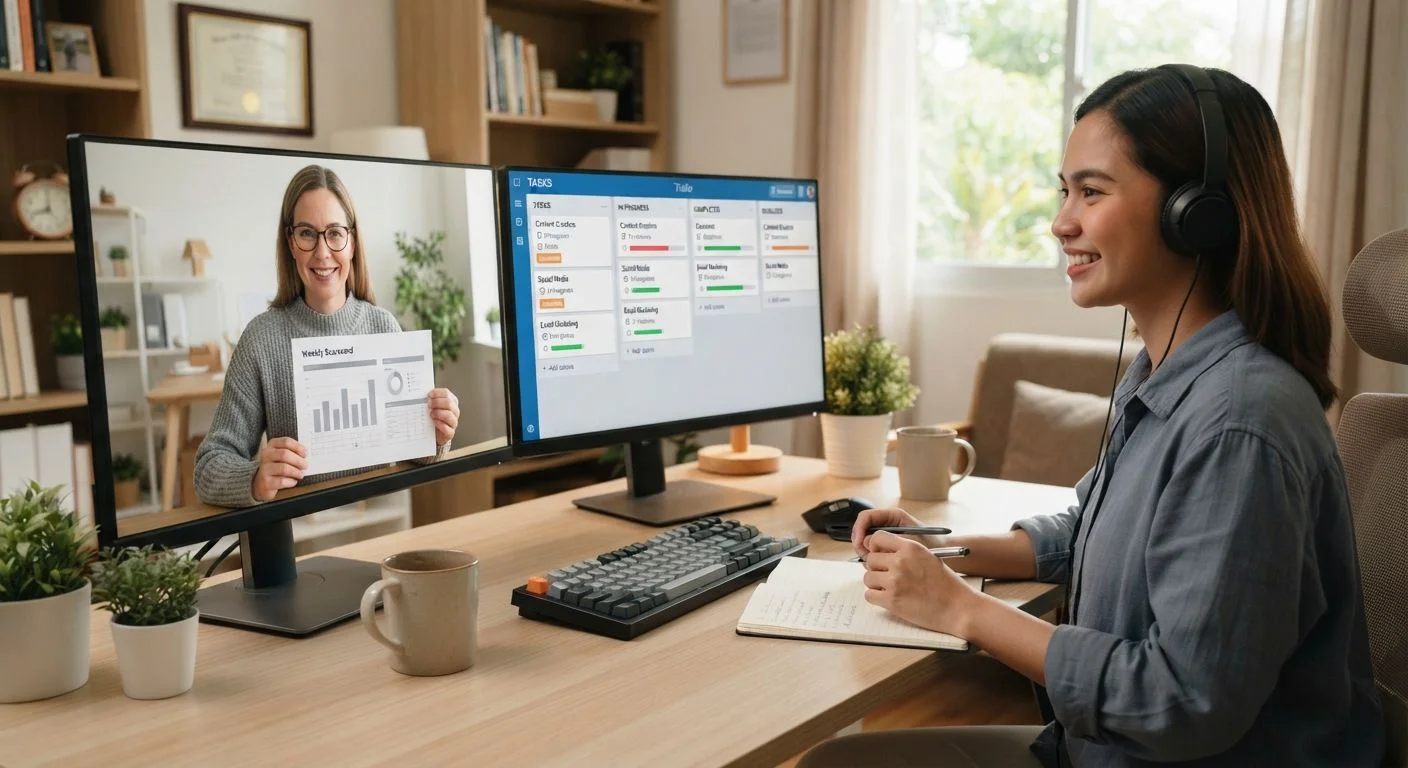
Image generated with AI
If you have hired a Filipino virtual assistant, you already know the single biggest source of friction in the relationship is not skill or work ethic, it is the clock. When you log off in New York at 6 PM, your Manila-based team is just starting their morning. Async communication with your Filipino remote team turns that 12 to 15 hour gap from a problem into a strength, but only if you build the right habits around it. This playbook walks you through the tools, rhythms, and documentation practices that let a US or Australian employer run a smooth, low-friction remote team without anyone waiting on a reply that will not come for another day.
Why async communication with your Filipino remote team works across time zones
The Philippines sits in UTC+8, which puts it roughly 12 to 15 hours ahead of most US time zones and only 0 to 2 hours ahead of Australian east-coast cities. That asymmetry is the whole story. With a US employer, the working days barely touch, so anything you run in real time is fighting physics. With an Australian employer, the days overlap heavily, which can lull you into treating the team like a local one when the fundamentals still benefit from writing things down.
For teams spread across three to five time zones, a widely used rule of thumb is to guarantee at least two hours of daily synchronous overlap where decisions can happen live. In practice, most cross-timezone teams protect a core window of about four hours for meetings, demos, and quick calls, and treat everything outside that window as an async lane. Adopting that split means you stop resenting the time difference and start planning around it. Your VA gets uninterrupted deep work during your night, and you get a full inbox of completed tasks by morning.
The async stack: Slack, Notion, and Loom (and what each is for)
You do not need ten tools. You need a small, boring stack that everyone uses consistently. A proven combination is Slack for conversation, Notion for written knowledge, and Loom for recorded walkthroughs, with task software layered on top.
- Slack is for chat, but use it deliberately. Keep discussions in threads so the channel does not turn into noise, and lean on Clips, Slack's built-in voice and video messages, when a written message would take three paragraphs to explain. A 90-second clip often replaces a long back-and-forth.
- Notion is your shared brain. Use it for a knowledge base, meeting notes, and a decision log that records why choices were made, not just what was decided.
- Loom is for video walkthroughs. Used by tens of millions of people, it lets your VA show you a bug, a design, or a new feature on their own schedule. You watch it on yours.
- Asana or Trello holds the actual work: tasks that each have an owner, a due date, and a clear status.
- Toggl is optional, but a simple time tracker gives you reliable data on where hours actually go when you cannot eyeball the team in person.
The rule is simple: choose the right tool for the job and stick to it. When chat and documentation live in the same place, history gets lost and every request becomes a treasure hunt.
Writing requests your VA can act on without follow-ups
Most async friction is not a time-zone problem. It is a writing problem. A vague request that needs three clarifying emails will always feel slower, no matter how the hours line up. To get work done on the first pass, every request you send should contain four things:
- The goal of the task, so your VA understands why it matters.
- A deadline, stated explicitly. "When you get a chance" is not a date.
- The acceptance criteria, meaning what done looks like.
- An example of done, a sample, reference, or past deliverable your VA can copy.
A poorly written request reads like this:
"Can you update the social media posts for next week?"
Your VA will not know which platform, what tone, whether to draft new content or schedule it, or when you need it. Expect a reply asking for details, then another round-trip, then a result that misses the mark. The whole thing takes three days.
A well-written request reads like this:
"Please draft and schedule next week's LinkedIn posts for our e-commerce brand. Goal: announce the new product line. Deadline: Thursday 3 PM your time. Acceptance criteria: three posts, each under 150 words, with a product image and the link to the store page. Here is last week's batch and the brand voice doc to match the tone. Reply when done."
That is the difference between a task that closes in one message and one that drags for days. Send complete context in the first message, and keep a single question per thread so answers stay fast and easy.
Daily and weekly rhythms: standups, updates, and reviews
Consistency is what makes async work. Pick a small set of recurring rhythms and honor them so everyone knows when to expect input and output.
- A short daily standup, written in Slack or sent as a two-minute Loom. Three lines: what you did yesterday, what you are doing today, and any blockers. It replaces the morning meeting entirely.
- A weekly written update in Notion instead of a status call. Your VA summarizes progress, wins, and upcoming work, and you read it whenever you have time.
- One weekly sync call in the overlap window for decisions, demos, and anything better said out loud. Keep it to 30 minutes and stick to an agenda.
None of this takes more than a few minutes a day, but together it keeps a team spread across oceans feeling like one team, because there is never a mystery about what anyone is working on.
When to go sync: protecting the overlap window
Async is the default, but not the only mode. Some things genuinely deserve a live conversation, and trying to force them into text wastes more time than it saves. Reserve the overlap window for the cases where real-time beats recorded:
- Decisions with trade-offs, where you need to weigh options together and check understanding on the spot.
- Demos and presentations, where reaction and feedback matter.
- Sensitive feedback, where tone is easy to misread in writing.
- Initial onboarding, when a new VA needs to ask questions freely and build rapport.
The test is simple: if it can be written, write it. If a message needs more than two rounds of back-and-forth to resolve, schedule a call. Using your four-hour core window only for these high-value moments keeps async fast for everything else.
Documentation as the backbone of an async team
Async teams run on documents, not on memory. When you and your VA work on opposite sides of the world, nothing can live only in someone's head. Three pieces of documentation keep the operation stable:
- A decision log in Notion, recording every meaningful choice, why it was made, and when. Six months from now, nobody has to ask why things are the way they are.
- SOPs (standard operating procedures) for every repetitive task, written once and reused forever. If a task happens more than once, document it.
- Documented onboarding, so a new hire or a returning contractor can get up to speed without taking up your calendar.
Documentation is the difference between a team that depends on one person and a team that survives any absence. Written well once, an SOP pays back the time spent creating it on the very next execution.
Checklist: make your Filipino remote team async-ready
- Protect two hours of daily synchronous overlap and treat the rest as async.
- Keep a small tool stack: Slack for chat, Notion for knowledge, Loom for walkthroughs, Asana or Trello for tasks.
- Put a goal, deadline, acceptance criteria, and an example of done in every request.
- Send full context in the first message and one question per thread.
- Run a short daily standup and a written weekly update instead of status meetings.
- Book one 30-minute weekly sync call for decisions, demos, and sensitive feedback.
- Write everything down: a decision log, SOPs for repetitive work, and documented onboarding.
Run these habits for a month and the 12 to 15 hour gap stops being a barrier. Your VA works while you sleep, your requests get answered on the first pass, and the time difference quietly becomes one of the best reasons you hired a Filipino team in the first place.
TopServicesPH Team
Guides and insights for hiring Filipino talent — and for Filipino freelancers building their remote careers.
Ready to hire?
Browse verified Filipino freelancers and contact them directly — free, with no commission.
Find talent